September 18, 2007

Share progressive web policies!

My independent study is starting to kick into high gear. The study's focus is on using the read/write web to support school-based induction of new and novice teachers. I am trying to understand the enabling conditions and barriers that must be considered before a professional learning community can flourish with these tools. It seems to me that one of the most important conditions to explore is the school system's policy regarding web publishing and appropriate use.

I am looking for examples of policies that embrace (rather than forbid) use of networks, blogs, wikis, instant messaging, and other web-based tools that encourage reflection and collaboration.

If you belong to a campus or school district that has recently refined, revised, or completely overhauled policy to reflect 21st century collaborative computer technologies, please contact me.

I am especially interested in how large, diverse public school systems are adapting. How did the reform effort start? What hurdles or stumbling blocks were encountered? And what does the final policy look like?

Please share your examples of progressive web policy!

technorati tags:


Share/Bookmark

September 15, 2007

Confessions of a blog disciple

cartoon from www.weblogcartoons.com

Warning: this post is opinionated, self-revelatory, and full of more questions than answers -- all the qualities that people who hate blogs cite as reasons for hating blogs.

Confession: I was once a blog-hating person.

When I first started keeping a blog, it was to fulfill a course requirement last spring. I even asked aloud in class, "Does the world really need another blog?" I honestly can't remember the professor's response to that utterance, because by March it didn't matter. I was hooked.

Last night after an agonizing few days of emailing back and forth with a local community leader in which I tried to express the shortcomings of our school system's web publishing policies, which seem to discourage student- and teacher-generated blogs, I sat at the dinner table feeling a bit demoralized. "I am so far removed from my original intent when I started graduate school. I don't know what I'm doing anymore," I told my husband.

How did I become this strident techno evangelist, selling salvation to sinners who think file sharing is the same as an email attachment and who still worship PowerPoint as the new posterboard?

Confession: I still use my cell phone strictly for making and receiving phone calls, every time I try to send a text message to my brother I screw it up, and until very recently I thought LOL meant "lots of love."

Originally, all I wanted to do was learn how to build web pages. At my former high school, which hasn't had a student newspaper since the 80s, I longed for a space where kids could publish for journalistic and literary purposes -- a web-based newspaper, or possibly a literary e-zine.

If you could only read the statement of purpose I submitted with my grad school application 18 months ago! Here's a snippet:
At the very least, I am hopeful that my coursework will equip me with the technical skills needed to develop a digital-age scholastic journalism program at Fulton High School, where I have taught since 1999. It is a personal and professional goal of mine to assist Fulton students in launching a journalistically sound online newspaper.

Not one mention of podcasts, wikis, or blogs. Why? I didn't know that stuff existed!

Now "blogs" is tied with "Web 2.0" as the third most populated category on ThinkTime. I'm obsessed with these tools and how to leverage them for my own personal and professional growth, and I want to share that excitement with others without alienating them or freaking them out.

But sometimes it seems I'm thinking more about the blog than through it. (As I compose this post at 10:30 on a Saturday night, I should be drinking a glass of red wine and watching Blades of Glory with the hubbie.) And, since making the decision to relocate, rename, and reformulate this blog a few weeks ago, I've been thinking even more about blogs:

  • Should I maintain anonymity, cultivate an online personality, or just be myself?

  • In addition to being a university student, I am also a parent, a part-time employee at a nonprofit with deep ties to our local school system, and a former employee of said school system: should there be a disclaimer on ThinkTime in which I claim my opinion as my own and no one else's? (I finally decided to follow Christian Long's advice.)

  • Would my learning improve if I spent less time on my personal blog and more time in high-traffic forums and online communities like those found in Classroom 2.0?

  • Will the passions near and dear to my heart -- writing, publishing, language arts and media education -- ever gain foothold on the pages in this site?

  • Am I contributing to the the ripe environment or just whistling in the wind?


Confession: I am an unapologetic teacher/learner on the upside of the learning curve, and I am having a blast!

And the more I read, the more convinced I am that falling under the spell of these powerful tools is a normal step in discipleship. In this post at LeaderTalk, a school administrator recognizes the learning curve and "wow" factor that must precede any new venture on the read/write web. And I take great comfort in Bud the Teacher's post, in which he acknowledges the need for play and experimentation before the teacher/learner can connect technology effectively to his or her classroom practice.

So, once again the question is: should we teach about the tools or through them?

The answer: Yes!

What do you think?

Cartoon by Dave Walker. Find more cartoons you can freely re-use on your blog at We Blog Cartoons.

technorati tags:


Share/Bookmark

September 14, 2007

Action plan for independent study, Fall 2007

After a recent consultation with my supervising professor, I have altered the subject and scope of my independent study on teacher mentoring and induction with 21st century tools. By "21st century tools" I mean free (possibly opensource), web-based products that facilitate teaching and learning through information sharing and production -- what many in ed tech circles call "Web 2.0," although I am going to try to avoid such jargon.

Here is my new focus: Rather than trying to match a tool or platform to the needs of an as-of-yet-unidentified pilot group of novice teachers, I will conduct an "environmental scan" or feasibility study of the best information and communication technologies available to support the creation of learning networks. What tools will enhance the reflective practice and growth of pre-service and new teachers? Which of these tools might assist building-level mentoring teams who plan and facilitate year-long induction of novice teachers?

These are the technologies I will evaluate (with specific examples in parentheses):

  • RSS and readers/aggregators (Bloglines, Google Reader)

  • tags/socialbookmarking (del.icio.us)

  • social networks (such as those built on the Ning platform)

  • content management systems and blogs (such as WordPress or Edublogs)

  • file sharing and collaboration (Google Docs, Box.net)

  • wikis (PB Wiki)


As I review each kind of technology, I will try to answer these questions:

  • First, what is it? How does it work? What does it do?

  • How could this technology support quality professional development? How does it align with quality indicators for professional development as outlined by the National Staff Development Council?

  • What enabling conditions must exist before teacher-to-teacher mentoring can take flight with this technology? (This is the most important part of the inquiry, getting close to what Ben Wilkoff calls The Ripe Environment. What kinds of change must occur in our attitudes to create institutional cultures that encourage innovation and collaboration? Wilkoff maintains talking about the tools is not the answer.)

  • What are the possible barriers or obstacles to consider when trying to integrate this technology for purposes of mentoring?

  • And for specific tools I will ask: How does this stand up to basic software evaluation criteria, such as user features, user interface, and help desk support? I will use Kathy Schrock's Software Evaluation Form as a start, but ultimately I hope to compile a specific list of criteria for assessing tools that support learning communities.


And, if available, I will share outcomes and evidence of impact in professional learning communities that have already integrated these technologies.

An overriding theme, the "super glue," if you will, that will hold all this together rests on my ability to relate in first-person narrative the impact these technologies have had on my own personal and professional growth as a teacher/learner.

The final inquiry will be packaged in wiki form, with the first installment due next week.

How's that for accountability and transparency?

technorati tags:


Share/Bookmark

September 10, 2007

Two perspectives on learning and leadership

Cross-posted at SchoolMatters (East TN, USA)

Our school system is undertaking a search for a new superintendent. Part of that process includes drafting a job description as well as selecting a head-hunting firm.

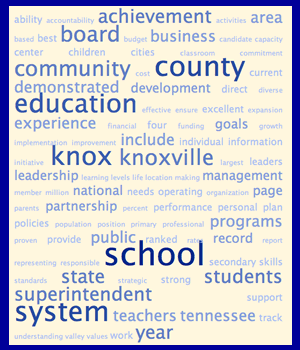
A 14-page draft of the job criteria is available to the public. Recently I took this text and created a tag cloud. In a previous entry, I posted the tag cloud as well as a short explanation of how I generated it.
SuperCloud

Generally speaking, I'm interested in understanding how we might interpret tag clouds and use them as visual summaries. After reading the superintendent job specs, I was struck by how much it was a reflection of our community -- our issues and assets, our values and our priorities -- as it was a description of an ideal instructional leader. For that reason, I thought it would make a cool visualization.

But how to interpret it?

Recently at the 21st Century Collaborative blog, Sheryl Nussbaum-Beach presented an interesting framework. I invite you to check out her post about "tactical" versus "strategic" perspectives and then take a second look at Knox County's approach. What are we seeking, stability or change? Where is our focus, inward or outward? What do we value, institutions or people?

What do you think?

technorati tags:


Share/Bookmark

September 6, 2007

Teachers: please take this survey!

I am collecting data for a mini-project in descriptive statistics. If you are a preservice or practicing teacher, I need your help.

Simply watch this short, six-minute video in which Dr. Richard Elmore of Harvard University discusses patterns of instructional practice in the United States. Then, click on the link below to complete a brief online survey.


I am ready to complete the online survey.
Powered by Wufoo

technorati tags:


Share/Bookmark

September 5, 2007

Tag cloud of superindentent specs

I've been waiting for an opportunity to play with TagCrowd, a tool that instantly generates tag clouds from text you paste, type, or upload at the site's home page.

I first learned of the TagCrowd application when I stumbled upon these clouds created from the April 2007 Democratic debates. While the clouds are by no means a substitute for actually listening to the debate or reading the transcripts, they provide a glimpse of the interplay between language and human values.

Recently, as part of its search to identify a new superintendent, the local school system here in Knoxville, Tennessee, released a 14-page "position specification" draft document that outlines the traits of an ideal candidate. I used this document to create a tag cloud.

A few word about how I made the cloud:

  • Out of a suggested range of 10-100 tags, I specified 100 tags to show in the cloud.

  • I also specified that similar words be grouped together, i.e. "learn" and "learning."

  • The generator does not count common words, such as "a" or "the."

  • I copied the text from a PDF file and pasted it into the window on the TagCrowd home page; I did not include the cover page or contact information on the last page of the PDF.


So, what do you think? What does the superintendent tag cloud reveal to you? What surprises you? What words are missing that you expected to see? What conclusions, if any, can you draw from the cloud?

SuperCloud

created at TagCrowd.com


technorati tags:


Share/Bookmark

Ice cream headache

A few weeks ago, Jeff Utecht posted an article about technology and student engagement at the Techlearning blog titled "Do you offer ice cream or toppings?"

Perhaps it's just the English teacher in me who can't resist a metaphor, but the post helped me think in new ways. Please read it!

In a nutshell, Utecht uses "ice cream" to represent the infinite, free, web-based tools and products currently transforming the information landscape as we know it. With all this free ice cream, teachers face an exciting and daunting challenge: how do we leverage students' unfettered access to information technology to create meaningful learning environments? In other words, what can schools offer students that they can't already have in unlimited, unrestricted quantities on the web? To quote Utecht:
How do we engage students who are used to information being free? How do we get students into our classroom so we can sell them the toppings? How do we get them to dig deeper and understand this free information? What is your topping? What is it that you can offer them that they cannot get anywhere else? How are you going to get them to dig deeper, to interact with knowledge rather than react from it? How are you going to engage students in the learning process and not allow them to be passive in their own learning?

My initial response to Utecht's challenge was all about the ice cream -- the tools, the products, the applications. I sidestepped the issue of "toppings," and in doing so, some might suggest I sidestepped the issue of good teaching, too.

After all, is my objective to teach about technology or through it?

As a language arts teacher, I understand the value of toppings -- opportunities for students not only to consume information but take it and make it their own. We don't just read good poetry, we connect with poetry by discussing or perhaps by writing an original poetic response. We don't just study grammar and mechanics, we integrate our knowledge of grammar and mechanics in peer editing exercises with authentic pieces of writings.

Still, I can't help but wonder if we are doing our students a disservice if we do not spend some time contemplating the tools themselves. So, I am pasting my response to Utecht below, and I invite you to comment:

This is an interesting metaphor. I've been thinking about it for a few days and have decided that my approach would be less about "toppings" and more about "taste testing."


In other words, what skills and knowledge do our students need to be discerning, conscientious consumers?

When it comes to ice cream, I look at fat content. The more the better because it's creamier and doesn't melt as fast. My husband is on a diet, so he asks for sugar free when it's available. On the other hand, my two-year-old son who only recently discovered the thrills of ice cream, will eat any flavor or variety you put in front of him. He even asks for ice cream for breakfast! And the after-effects of too much ice cream? Don't get me started.

In the same way that just about every person you meet has an "ice cream story," just about every student you meet these days will already have a lot of previous technology experience. (Some more than others, and, like the very best ice cream, that would be a problem of access and affordability, wouldn't it?)

With that in mind, I imagine it would be really easy on the first day of class to engage the "I generation" in a conversation about their likes, dislikes, and expectations regarding technology. What makes some tools/applications better than others? Let the students generate a list of some criteria, and then as the teacher introduces new tools/apps (flavors? brands?), the students are held accountable for using those evaluation criteria. I imagine as the semester progresses, this rubric of sorts will evolve and change as the students become even more savvy and conscientious consumers/users.

More ice cream metaphor: it's ubiquity, endless variety, and general affordability makes it easy to incorporate into our daily lives. (How many people have you met who admit to eating at least a small amount of ice cream, or chocolate, every day?) More questions arise from this fact: how much is too much? how do we manage a balanced diet? and what about all that free stuff? what if some day it's not free? (I think about that a lot when I use Google and such.)

My husband is currently watching his carbs, but in his day, he was a homemade ice cream connoisseur. And it had to be hand-cranked, no electric ice cream makers!! And everyone who planned to eat the ice cream had to take a turn at the crank.

Sounds a lot like open source, doesn't it?

What do you think?


Share/Bookmark