Showing posts with label EP604. Show all posts

July 28, 2011

More reflections on CAQDAS

A few years ago while working on my master's in Instructional Technology, I was searching for creative uses of the ubiquitous PowerPoint and stumbled upon a column by artist/musician David Byrne in which he described his first encounter with the presentation software.  Byrne hated the application, calling it "limiting, inflexible, and biased." Despite this, Byrne decided to take up the medium anyway, in order to satirize it.

Then something strange happened.

Byrne realized he could make PowerPoint function as a "metaprogram" in which he could organize all his multimedia content into something "beautiful." He wrote, "I could bend the program to my own whim and use it as an artistic agent.... I could make works that were 'about' something, something beyond themselves, and that they could even have emotional resonance."

Guided by his curiosity and artistic vision, Byrne successfully and effectively co-opted an evil business software and turned it into a creative platform.  This idea really appealed to me at the time because we classroom teachers have been doing that sort of thing for a long time (gradebooks in Excel spreadsheets, writing workshops in MsWord).  

I was reminded of Byrne's artwork this week as I completed the EP604 course readings on CAQDAS, several of which made mention of the historical distrust of computers among some qualitative researchers. In their 1996 paper Qualitative Data Analysis: Technologies and Representations, which, interestingly, was published in what had to have been one of the very first digital journals of social science research, Coffey, Holbrook and Atkinson describe a tension between the increasingly diverse methods of contemporary ethnographic research and a trend towards homogeneity imposed by the "computing moment."

A section of Seale's chapter in Doing Qualitative Research poses this question: "Do computers impose a narrowly exclusive approach to the analysis of qualitative data?" (p. 257)

Following this week's readings and then last night's class discussion, I am convinced the answer is "no." The early fears about "orthodoxy" and "homogeneity" are unfounded. It seems that the qualitative researcher, confident of and consistent in her own methodology, can leverage the power of these seemingly positivist tools to do some powerful meaning making (Friese, 2011; Seale, 2010).

As a former public school teacher, I know a little about oppressive orthodoxies. There is an insidious strain of orthodoxy that pervades K-12 education, and it goes by the innocuous name of "best practice." It's actually very odd. Teachers are told, on the one hand, to implement research-based best practices, while, on the other hand, most progressive education reforms focus on making instruction individualized and learner-centered, not scripted and standardized. In other words, what's "best" for one child may not be "best" for another.  The only "best" practice is what works at a given time, in a given context, with a given student.

Now, as a novice qualitative researcher, I am visiting my classmates' blogs, attending software webinars, participating in EP604 class discussions, and thinking about "best practices" again, this time in light of "digital convergence" (Brown). The digital tools, by their very design, are exploding the notion. Rather than impose a singular and "right" way, the tools are to be explored, evaluated, and adapted to fit our epistemological and methodological needs (Brown; Friese; Seale).

For example:

  • Last night we were provided an overview of two CAQDAS tools, QDAMiner and Transana. Both programs imposed an a priori approach to coding, but our instructor suggested a trick to bypass that: simply create a generic code such as "quotes" or "clips" to use during the first cycle of coding.
  • In her article Using Atlas.ti for Analyzing the Financial Crisis Data, Friese describes in detail how, feeling the grounded theory approach to be inadequate, she devised her own idiosyncratic analytic procedures, which slowly evolved into what she calls "computer-assisted NCT analysis."  In her conclusion, Friese asserts that her coding and analysis process would be the same regardless of the software package she chose.
  • In an earlier post I shared what I was learning about Mendeley which performs double-duty as both a citation manager and a collaborative platform for scholarly research. According to its developers, Mendeley is highly individualized to fit the "idiosyncratic processes of researchers." I wondered about Mendeley as a place for self-publishing.Could it be it is the very embodiment of Brown's "scenario," in which the "massification" of "combined technologies could...provide the opportunity for the proliferation and democratization of the production and dissemination of qualitative research knowledge"? 
Mendeley as a "scholarly Facebook"? Probably not. But I like to think about the possibilities. Even Coffey, Holbrook and Atkinson (1996) concluded that the contemporary ethnographer should give the proliferation of digital tools "serious and systematic" attention or risk becoming a "dreadful anachronism."

P.S. Just for fun, here is a PowerPoint animation set to a remix of Canon in D.  Nothing anachronistic here.



Share/Bookmark

July 26, 2011

Reflection on Atlas.ti

Last night in class, we practiced performing data analysis with Atlas.ti, and the exercise confirmed a nagging suspicion: I have grossly underutilized the functions of this CAQDAS tool. There are so many features and options inside the Atlas.ti environment, and, to quote our instructor, "at least 12 different ways" to perform each function. As we gathered up our things to go home, one of my classmates remarked that she felt like she had "run a marathon."

I've run a few laps already with Atlas.ti, using it to code data for two small projects within the past year.  Yet, even I was mentally and physically wasted after last night's workout.

Maybe "triathlon" is a better way to describe what it's like to work in the flexible and multifaceted environment of Atlas.ti. Konopasek (2008) referred to the "sophisticated interface" of CAQDAS tools in general and then specifically described Atlas.ti's "visualisation" capabilities, in which the researcher's "thoughts or mental operations can easily be stored, recollected, classified, linked, filtered out in great numbers...and made meaningful in sum."

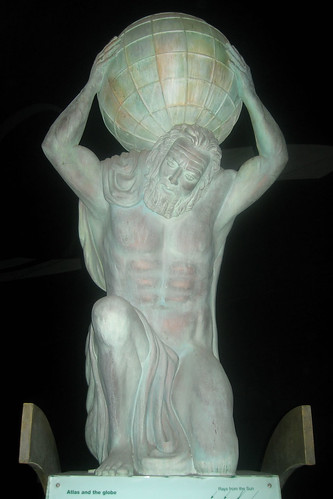
Some rights reserved by hmcotterill
Is this why the Atlas.ti developers named their product after the mighty hero of Greek myth, the one who bore the weight of the world on his shoulders?

Something else strikes me as powerful about Atlas.ti and the other digital tools we are exploring. Again and again in the EP604 course readings, I've noticed the suggestion that technology is blurring the lines between the strict, paradigmatic camps -- quantitative vs. qualitative, positivist vs. constructivist.

Seale (2010) tells us that the "counting" capabilities of CAQDAS software "is a reminder that the days of a great divide between qualitative and quantitative research work have now largely passed" (p. 255). And I am intrigued by Konopasek's comparison of Atlas.ti to a "textual laboratory." The metaphor literally co-opts the venue most commonly associated with scientific and positivist inquiry.

I am no statistician, but I like the way Atlas.ti enables the qualitative researcher to perform quantitative functions such as frequency counts and the "Word Cruncher," not as an end-all-be-all of analysis, but as a jumping off point for deeper exploration of connections, patterns, and new meanings.

For example, the first time I used the software, I ran a frequency count for a particular phrase in my transcripts just to confirm a hunch before I started coding.  I realize I could have used the "find" and "comment" tools in MSWord to perform these simple operations, but it was what I was able to do after coding that sets Atlas.ti apart from a word processor. I began looking for the co-occurrence of three specific a priori codes based on the TPACK framework (technology, pedagogy, and content).  Turns out, that didn't happen much in my transcripts, but Atlas.ti did help me to see more than twenty intersections between the "technology" and "pedagogy" codes.  This sent me down an altogether different and fruitful path of inquiry.

These previous experiences with Atlas.ti are the equivalent to running sprints. Now, after having received some guided, hands-on instruction, I have a clearer vision of how Atlas.ti. can function as an all-inclusive research notebook, containing fieldnotes, comments, memos, codes, and a seeming infinite variety of visual, textual, and statistical outputs generated by the researcher. I am ready to go the distance.

Share/Bookmark

July 25, 2011

EP604 skill-building activities

Here are my two ideas for skill-building projects in EP604:
  • Mendeley  I will complete my profile, join some public groups (perhaps?), build and organize my library, and figure out the best way (that works for me) to upload, store, and share annotated PDFs.  If I have time, I would like to compare Mendeley to Zotero, which I used last year on a collaborative lit review about podcasting.  I haven't played with Zotero in a while. I see this project as supporting my personal goal to go paperless this year. See Working with Mendeley and More on Mendeley for my current reflections on this project.
  • Inqscribe  I will use this tool to complete transcription for a study on the use of eBooks during Kindergarten literacy instruction. This project will challenge my skills at reflexivity because the lead investigator on the study has not prescribed a format for the transcripts.  As I teach myself how to create "shortcuts" and "snippets" with Inqscribe, I will also have to use my developing expertise about the transcription process to figure out how to accurately and adequately represent the essence of children's emergent readings. This is crucial, as the data will be interpreted to determine what impact exposure to eBooks had on their developing literacy.

Share/Bookmark